
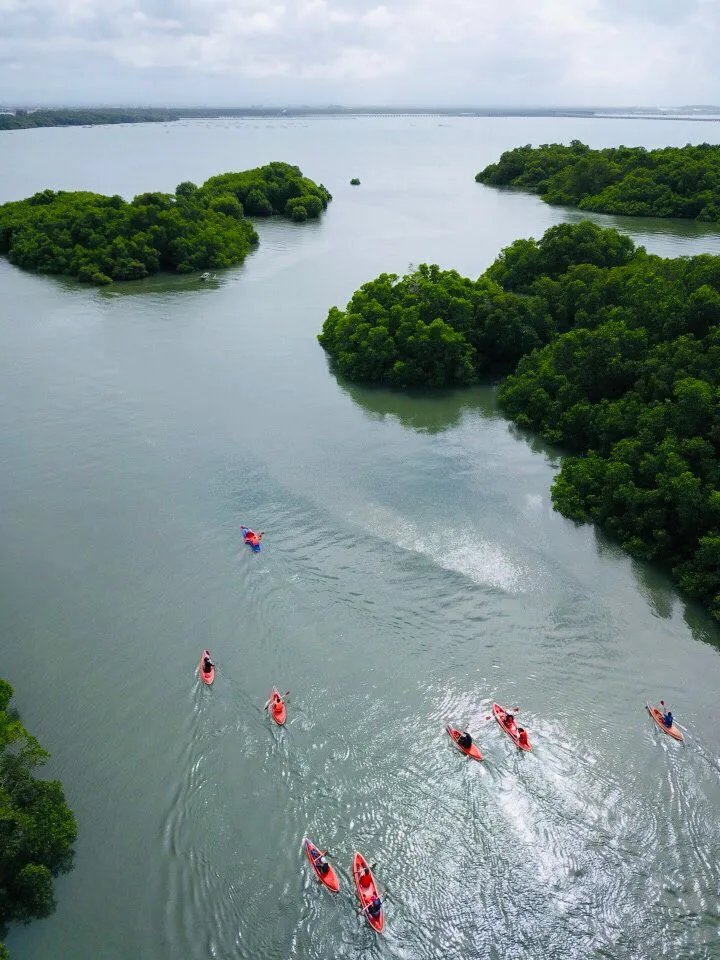
Where land and ocean meet, mangroves create one of the most useful coastal ecosystems on the planet. Their roots stabilize shorelines, provide shelter for fish and other wildlife, and store significant amounts of carbon in both vegetation and sediment.
This 2026 update keeps the original article’s environmental focus, removes generic stock imagery and unsupported claims, adds stronger Indonesia-specific context, and connects the story with current community-based mangrove experiences in Bali.
Mangrove conservation matters because one ecosystem delivers several benefits at once: coastal protection, biodiversity, fisheries habitat, carbon storage and local livelihoods. Indonesia has around 3.4 million hectares of mangroves — more than 20% of the world’s total — giving the country an especially important role in global mangrove protection.
Experience Bali’s Mangroves Responsibly
Choose a guided canoe or stand-up paddle experience, or ask us about a group mangrove planting / CSR program.
Why Mangroves Matter
Mangroves thrive in coastal environments where many other trees cannot. Their complex root systems help stabilize sediment and reduce shoreline erosion, while sheltered waters create nursery and feeding areas for fish, crabs and other marine life.
Root systems help hold sediment and reduce erosion and wave impacts.
Fish and other organisms use mangrove areas for nursery, shelter and feeding.
Mangroves connect terrestrial and marine ecosystems and support birds, reptiles and other wildlife.
Healthy coastal ecosystems support fisheries, food security and income for many communities.
Mangroves and Blue Carbon
Mangroves are important blue-carbon ecosystems. Carbon is stored not only in trunks, branches and leaves, but also in waterlogged soils where organic material can remain for long periods.
Indonesia’s mangroves are estimated to store billions of tons of carbon. Instead of repeating the old article’s broad “five times” claim, this update uses a safer conclusion: Indonesia’s mangrove carbon stocks are exceptionally high and can be considerably greater per hectare than those of tropical rainforests.
Why Mangrove Conservation Is Still Necessary
Mangroves can be damaged or lost through coastal development, land conversion, pollution, altered water flows and other pressures. When the ecosystem disappears, the loss is not limited to trees. Habitat, carbon storage, fisheries productivity and shoreline resilience can decline with it.
Preventing degradation can be more effective than trying to recreate a mature ecosystem later.
Planting works best when species, tidal conditions and site hydrology are suitable.
Local knowledge and long-term stewardship matter after planting day ends.
Coastal cleanup and responsible waste management can support healthier mangrove areas.
Indonesia’s Global Mangrove Role
Indonesia has the world’s largest mangrove estate. World Bank material based on Indonesia’s 2021 National Mangrove Map puts the area at around 3.4 million hectares, representing more than 20% of global mangroves.
That scale makes Indonesian mangrove protection important not only for biodiversity and coastal communities, but also for climate policy. Mangroves are a major part of Indonesia’s blue-carbon and coastal-resilience potential.
Mangrove Conservation in Bali
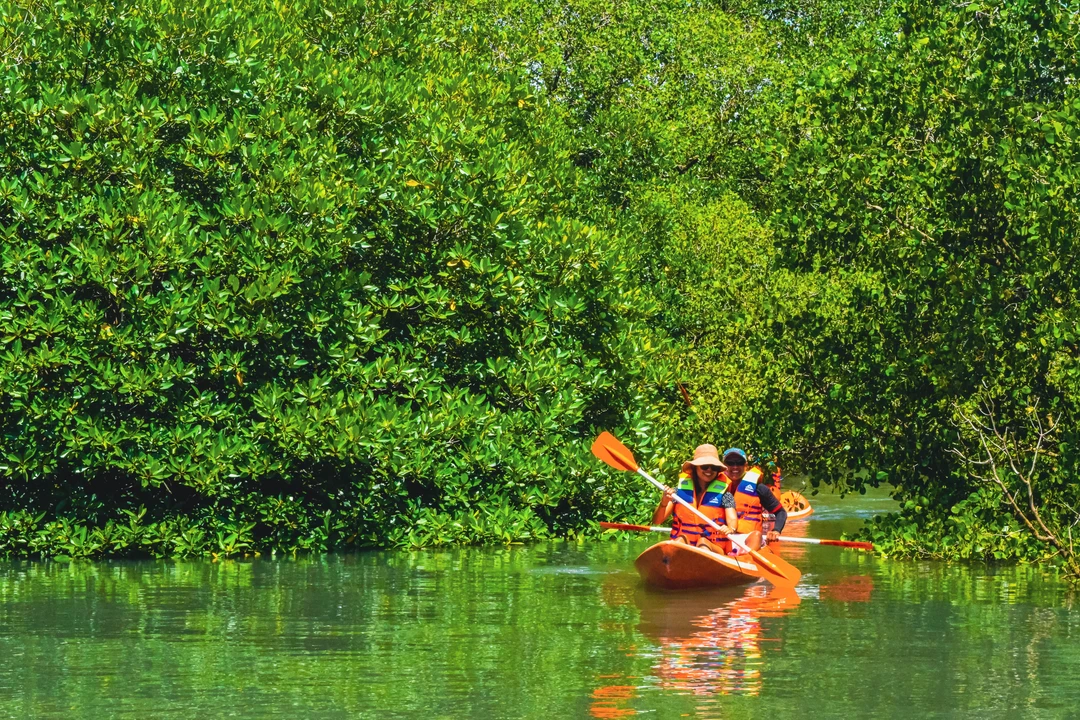
In southern Bali, Kura-Kura Bus works with Wana Segara Kertih, a local fishermen’s community involved in protecting and managing the mangrove environment around Kedonganan.
Current guided experiences begin and end at Wana Segara Kertih. Guides introduce participants to mangrove flora and fauna and explain why the ecosystem matters to coastal communities.
What Can Travelers Do?
Understanding the ecosystem makes a mangrove visit more meaningful than simply treating it as a photo location.
Canoe and SUP routes move slowly through the waterways and include environmental interpretation.
Mangrove activities depend on water conditions. A changed route is often a safety decision.
Choose experiences that involve local guides, community groups and conservation education.
Bali Mangrove Experiences with Kura-Kura Bus
Bali Mangrove Canoe Tour
Child price: IDR 425,000. Guided canoeing lasts around 1–1.5 hours within an overall program of roughly 2 hours.
Single or tandem canoe/kayak, life jacket, first aid, licensed English-speaking guide, transfer, donation, water, tax and insurance are included under the current product conditions.
Bali Mangrove SUP Tour
Guided stand-up paddle activity of around 1–1.5 hours, with safety briefing and basic instruction before entering the mangrove waterways.
The current public product page positions the experience as beginner-friendly and includes paddle equipment, life jacket, guide, transfer, donation, water, tax and insurance under the product conditions.
Mangrove Planting & CSR
JTB Indonesia and Kura-Kura Bus have previously carried out mangrove planting and coastal-cleanup activities with Wana Segara Kertih.
Program design can depend on group size, date, tide, site conditions and the CSR or SDGs objective.
From Awareness to Action: Mangrove Planting in Bali
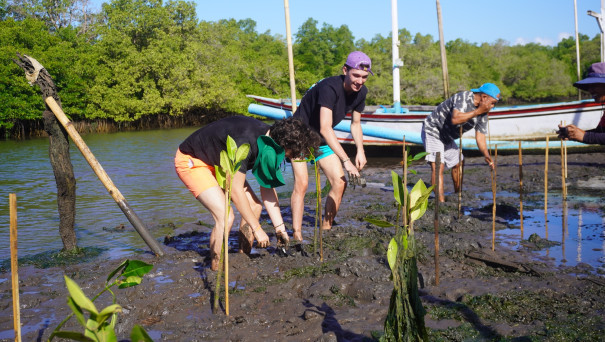
Planting can be a powerful conservation activity, but the value does not come from the number of seedlings alone. Effective restoration needs the right species, the right tidal environment, suitable hydrology and follow-up care.
In July 2025, JTB Indonesia worked with Wana Segara Kertih on mangrove planting and coastal cleanup through the JTB Brighter Earth Project. For travelers, schools and companies, a carefully designed program can combine hands-on activity with environmental learning.
See more about the impact of mangrove planting in Bali.
Mangrove Conservation: The Bigger Picture
Mangroves are often described as “roots of the sea,” but conservation is really about the entire system around those roots: water, sediment, wildlife, fisheries, nearby communities and the climate.
For travelers, the most useful contribution is not simply to visit. It is to choose experiences that make the ecosystem easier to understand, respect local management and direct tourism value toward people who have a reason to keep the mangrove forest healthy.
Frequently Asked Questions About Mangrove Conservation in Bali
Why are mangroves important?
Mangroves protect coastlines, provide habitat and nursery areas for marine life, support biodiversity, store large amounts of carbon, and contribute to coastal livelihoods.
How much mangrove does Indonesia have?
Indonesia has around 3.4 million hectares of mangroves, representing more than 20 percent of global mangrove area according to World Bank material based on Indonesia’s 2021 National Mangrove Map.
Are mangroves important for climate change?
Yes. Mangrove ecosystems store large amounts of blue carbon in vegetation and especially in waterlogged soils, making conservation and restoration relevant to climate mitigation as well as coastal resilience.
Can tourists experience mangroves responsibly in Bali?
Yes. Guided canoe and stand-up paddle activities can introduce visitors to the ecosystem while supporting conservation awareness and community-based initiatives.
How much is the Bali Mangrove Canoe Tour?
The current Kura-Kura Bus canoe tour is listed at IDR 850,000 per adult and IDR 425,000 per child.
How much is the Bali Mangrove SUP Tour?
The current public Kura-Kura Bus product page lists the SUP experience at IDR 880,000.
Can children join the mangrove canoe tour?
The current canoe product has a minimum age of 5 years. Insurance applies to ages 5 to 65, and pregnant guests are not permitted to join.
Can companies arrange mangrove planting or CSR activities in Bali?
Kura-Kura Bus and JTB Indonesia have previously carried out mangrove planting and coastal-cleanup activities with Wana Segara Kertih. Groups can contact Kura-Kura Bus to discuss a current program.
Explore Bali’s Mangroves — or Build a CSR Program
Send us your travel date, group size and hotel area. For corporate or educational groups, also tell us your sustainability or SDGs objective so we can discuss the most suitable program.
WhatsApp: +62 812-3729-3689
Email: kura_rsv.id@jtbap.com
