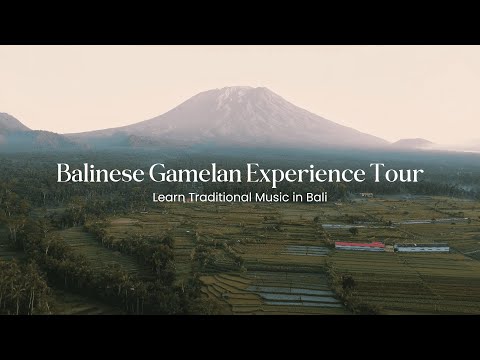
In Bali, art is not always separated from ordinary life, community responsibility, or religion. Music accompanies dance and ceremony. Carving shapes gateways and ritual objects. Textiles identify roles and transform spaces. Offerings appear outside homes and businesses. A performance may entertain an audience, support a temple festival, transmit a story, or do several things at once.
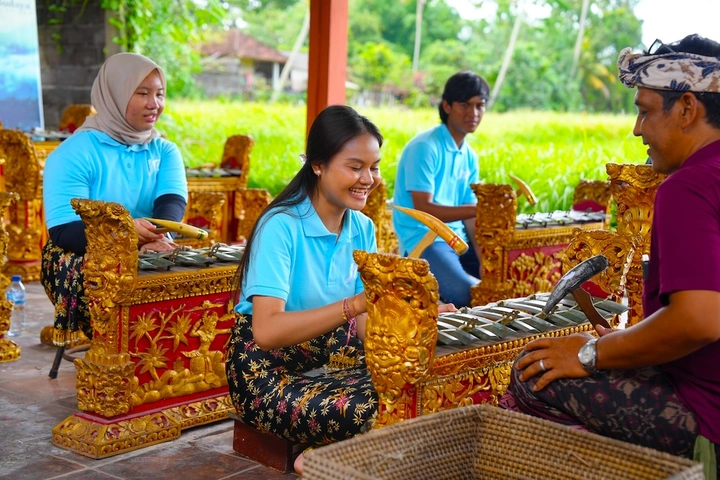
Visitors often encounter the visible result—a decorated temple, a dancer in costume, a row of bronze instruments—but not the relationships behind it. Who made the object? Who taught the performer? Why is the ensemble tuned as a set? Who prepared the space, offerings, clothing, and food? What changes when a sacred form is presented on a public stage?
This guide is an introduction, not a dictionary of every Balinese tradition. It explains how to look and listen more carefully, how to separate public experiences from restricted ritual contexts, and how a hands-on experience such as Discover Balinese Gamelan can reveal the cooperation behind the sound.
Six layers to notice
| What you encounter | What to notice | How to respond |
|---|---|---|
| Daily offering | Placement, materials, timing, and purpose | Do not step on, move, or stage it for a photograph |
| Gamelan ensemble | Interlocking parts, tuning, leadership, and group listening | Follow the instructor and treat instruments with care |
| Dance performance | Gesture, eyes, posture, costume, story, and musical cues | Distinguish public performance from ceremonial context |
| Temple art | Gateways, sculpture, textiles, spatial hierarchy, and renewal | Enter only permitted areas and follow dress requirements |
| Artisan workshop | Materials, tools, repetition, apprenticeship, and labour | Ask before photographing and value the maker’s time |
| Ceremony | Community participation rather than visitor spectacle | Keep distance, stay quiet, and follow local direction |
These categories overlap. A carved object may be both artistic and ritual. A musician may perform in a temple one day and for visitors another. A textile can carry aesthetic, social, economic, and ceremonial meaning.
Avoid forcing every encounter into a simple choice between “authentic” and “touristic.” Traditions can adapt, performers can work professionally, and visitor experiences can still be respectful. More useful questions concern context, permission, community participation, interpretation, and who benefits.
Begin with everyday offerings
Small offerings often called canang sari can be seen on pavements, shrines, vehicles, counters, and entrances. Their materials may include woven palm leaf, flowers, food, incense, and other elements arranged according to purpose and local practice.
They are not street decoration. They are acts within daily religious life. Their meaning cannot be understood only from colour or composition, and not every offering encountered across Bali is identical.
Watch where you step, particularly near doorways and busy pavements. Do not move an offering to make a photograph cleaner, place a product beside it, or ask someone to repeat the act of presenting it for your camera.
If you are invited to learn about making an offering, listen to the explanation before treating the activity as craft. Ask what the materials mean, when the offering is used, and what visitors should or should not do with the completed piece.
Ritual is more than what a visitor sees
A ceremony may involve preparation over days or weeks, community labour, music, food, dress, processions, prayer, offerings, cleaning, transport, and obligations invisible to a passing visitor.
Seeing one moment does not mean you understand the whole event. Avoid declaring a ceremony’s meaning from appearance alone or repeating an explanation from social media as universal truth.
When a procession affects traffic, remain patient. Do not walk through participants, block an entrance, or stand above people praying. Follow instructions from temple staff, residents, police, or your guide.
Some areas, objects, performances, and moments are restricted. A gate being open is not permission. Ask before entering, filming, flying a drone, or using professional equipment.
Gamelan is an ensemble, not one instrument
UNESCO describes gamelan as both the traditional Indonesian percussion orchestra and the set of instruments used. Ensembles commonly include metallophones, gong-chimes, gongs, drums, cymbals, and in some traditions voices, strings, or flutes.
There is no single universal gamelan. Instrumentation, tuning, repertoire, tempo, playing technique, and social function differ across islands and between Balinese ensembles. Even within Bali, Gong Kebyar, Semar Pegulingan, Angklung, Gambang, Selonding, and other forms have different histories and uses.
The word should therefore not be used as if it means one standard scale or a portable collection of interchangeable instruments. An ensemble is built and tuned as a related set. Moving one instrument into another ensemble is not always musically meaningful.
Listening for interlocking parts
One of the most revealing ideas in Balinese gamelan is that a rapid musical line may be divided between players. Each person performs part of the pattern, and the combined result moves faster than either individual part.
This interlocking principle is often described through paired relationships. It depends on timing, attention, physical memory, and awareness of the other player. Playing louder or faster does not make the ensemble better if the relationship breaks.
Listen for layers. A drum may guide changes and energy. Lower instruments may carry a more foundational melody. Higher instruments create elaboration. Gongs mark larger cycles. Cymbals add force and texture. The exact roles depend on the ensemble and composition.
For a beginner, the lesson is immediate: the music cannot be reduced to individual self-expression. Your part makes sense because other parts surround it.
Why tuning sounds different
Visitors sometimes describe gamelan as “out of tune” because it does not match equal-tempered piano tuning. That judgement applies the wrong system.
Balinese instruments may be deliberately paired with slightly different tunings, producing a shimmering acoustic effect. The relationship between paired instruments contributes to the ensemble’s living, vibrating sound.
Tuning is specialised work. Gong-smiths and instrument makers shape metal, adjust pitch, listen across the set, and respond to the musical tradition for which the instruments are intended.
A workshop visit makes this easier to appreciate. The finished bronze surface is only the visible end of repeated heating, hammering, shaping, cooling, measuring, listening, and correction.
From fire and metal to ceremonial sound
The Discover Balinese Gamelan experience begins with a gong-smith workshop in Blahbatuh Village. This places craftsmanship before performance.
Guests can observe how gongs and related instruments are made by skilled artisans using knowledge transmitted through families and workshops. The setting is a working environment, not a staged souvenir demonstration.
Follow safety boundaries around heat, tools, metal, and active work. Do not touch materials or equipment without permission. Ask before photographing artisans, especially during concentrated or hazardous tasks.
Recognise the labour involved. A ceremonial gong is not merely an object purchased at the end of a production line; it connects material knowledge, acoustics, visual craft, music, and community use.
What happens during the hands-on session
After Blahbatuh, the current programme continues to Batusepih Village for a beginner-friendly session with local musicians. A light refreshment is provided before or during the experience according to operations.
No musical background is required. The instructor introduces basic rhythm, coordination, and ensemble structure. Participants try authentic instruments and gradually combine parts.
Do not expect to master a composition in one visit. The value lies in experiencing the concentration required to enter together, repeat a pattern, listen across the group, and stop at the correct cue.
Hold mallets as instructed and use the playing technique demonstrated. Striking too hard can damage an instrument or produce an uncontrolled sound. Some metallophones require one hand to strike and the other to damp the previous note; this coordination takes practice.
The experience at a glance
The current direct listing describes a half-day cultural experience, while the activity badge may show approximately two hours for the central experience. Total time from hotel pickup to return can be much longer because the route includes transfers, the Blahbatuh workshop, Batusepih session, and return journey.
Pickup is currently available from centrally located hotels in Kuta, Legian, Tuban, Sanur, Jimbaran, and Tanjung Benoa. Nusa Dua and more distant areas such as Ubud, Canggu, Uluwatu, Tabanan, Candidasa, or Singaraja may require surcharges, and some distant pickups may not be recommended.
Current inclusions list air-conditioned non-smoking transport, an English-speaking licensed guide, entrance fee, tax, local instruction, refreshment with mineral water, coffee or tea and Balinese rice cake, and insurance. Lunch, personal expenses, and gratuities are excluded.
The live product page has listed a two-adult minimum and IDR 650,000 per adult, but pricing and booking rules can change. Confirm the current total, minimum participants, pickup surcharge, duration, and cancellation terms before payment.
Who will enjoy the gamelan experience?
The session suits musicians, non-musicians, families, couples, cultural travellers, educators, and visitors who prefer participation to passive sightseeing.
Musicians should arrive ready to learn a different system rather than demonstrate existing ability. Western notation, piano training, or percussion experience may help coordination, but it does not replace listening to the local instructor.
Children may enjoy the physical immediacy of the instruments, but parents must supervise and ensure they can follow volume and handling instructions. Confirm current child participation and pricing before booking because the direct listing may not display a standard child rate.
Travellers sensitive to loud sound should bring appropriate hearing protection and discuss seating. Workshops may also be hot and noisy. Contact the operator about mobility, respiratory, sensory, or medical needs.
Gamelan and dance are connected
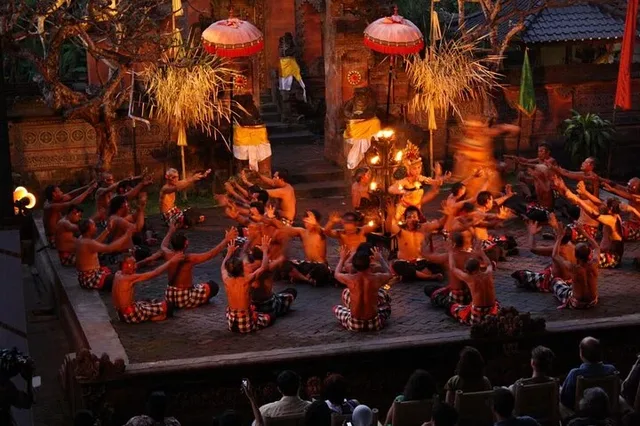
Balinese dance depends on music for more than background atmosphere. Musical changes signal entrances, gestures, emotional shifts, speed, and dramatic structure. Dancers and musicians respond to one another.
UNESCO’s description of Balinese dance recognises sacred, semi-sacred, and community-entertainment genres, accompanied by gamelan. This framework helps visitors understand why not every dance has the same function or access rules.
Watch the eyes, fingers, shoulders, torso, and changes in weight. Facial expression communicates character and emotion. Costume and makeup help define roles, but movement and musical relationship bring them to life.
Do not label every masked or dramatic performance “traditional” without context. Ask the name, story, function, venue, and whether the version is ceremonial or staged for a general audience.
Sacred, semi-sacred, and public performance
Categories can help, but they should not be used to make absolute claims without local knowledge. A form may have particular restrictions in one village or ceremony and a different presentation context elsewhere.
Sacred dances and music may be connected to specific temple spaces, ritual calendars, or community responsibilities. Semi-sacred forms can support ceremony while also containing dramatic or narrative elements. Public performance forms may be presented for broader enjoyment and tourism.
Visitors should follow the rules of the actual place rather than assume a category learned online grants permission. Photography, seating, dress, and access can change according to the occasion.
A paid public show is not automatically disrespectful. Artists deserve income, training opportunities, and audiences. The important questions are whether the presentation is appropriate, performers are treated professionally, and visitors receive accurate context.
Temple architecture is organised space
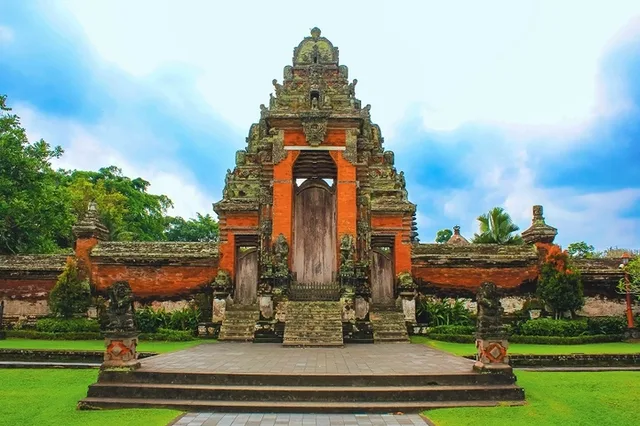
Balinese temples are not simply collections of decorative gates and statues. Spatial organisation, courtyards, orientation, shrines, gateways, walls, and levels help define movement and access.
A guide can explain broad principles, but temple layouts and rules vary. Visitors may be permitted in one courtyard but not another. Access can change during ceremonies, maintenance, or community preparation.
Do not climb a gateway, shrine, wall, guardian figure, or platform. Do not sit higher than worshippers, stand in front of prayer, or place bags and bodies on structures because they appear photogenic.
Stone surfaces may look ancient even when they are maintained or recently carved. Renewal is not evidence that a place is inauthentic. Living temples require repair, replacement, cleaning, and continued craft.
Carving, painting, textiles, and objects
Balinese carving appears in stone, wood, architecture, masks, furniture, and ritual objects. Motifs may have narrative, protective, symbolic, architectural, or aesthetic roles. Not every dragon-like figure or floral pattern has one universal meaning.
Painting traditions have developed through courts, villages, religious stories, modern artistic movements, tourism, and individual experimentation. “Balinese painting” is not one timeless style.
Textiles can indicate ceremony, status, community identity, protection, decoration, or dress requirements. Sarongs and sashes used by visitors are practical parts of respectful temple clothing, but other textiles may have restricted or specific significance.
Ask makers about materials, time, technique, and intended use. Buy directly where possible, but do not assume every shop is also a workshop or that every object is made locally.
Choosing an artisan workshop responsibly
A good workshop allows time for explanation, does not pressure visitors into buying, and makes clear whether the activity is observation, participation, or both.
Look for evidence of real practice: tools, materials, stages of work, specialist knowledge, and a person able to explain technique. Respect safety boundaries and production schedules.
Do not ask an artisan to complete a complex piece quickly for entertainment. Do not bargain aggressively over work that required substantial time and skill. If you commission something, agree on materials, dimensions, price, delivery, and shipping responsibilities in writing.
Photography should be requested, especially where designs, family processes, clients, or sacred objects are involved.
Ubud, Gianyar, and artistic communities
Ubud is strongly associated with galleries, dance, music, and painting, but the broader Gianyar region includes many villages known for particular forms of craft and performance. Blahbatuh and Batusepih demonstrate why meaningful cultural experiences extend beyond central Ubud.
Avoid treating village specialisation as a theme park map. People move, learn, collaborate, study, and sell work across regions. A village associated with one craft still contains ordinary homes, schools, businesses, agriculture, and religious life.
Plan enough travel time. Short map distances can take longer because of traffic and local events. Combining many workshops in one day can reduce each encounter to shopping.
One careful visit with a knowledgeable guide is usually more valuable than moving rapidly between several “art villages.”
Photography, recording, and intellectual respect
Ask before photographing a person closely, recording an instructor, filming an entire lesson, or documenting a workshop process. Permission to observe is not automatic permission to publish.
At performances, follow the venue’s restrictions. Avoid flash, bright screens, tripods in aisles, and recording that blocks other viewers. At ceremonies, rules may be stricter or photography may be inappropriate entirely.
Do not reproduce a sacred design, mask, composition, or ritual object as a commercial logo or product simply because you photographed it. Cultural material is not automatically free of community meaning or artistic ownership.
Caption images accurately. If you do not know the name or function of something, say so or ask before publishing a confident but incorrect explanation.
Temple and ceremony etiquette
Wear required temple clothing, often a sarong and sash, and keep shoulders and legs appropriately covered according to local instruction. Rules vary, so follow the site rather than rely only on a general guide.
Do not enter when bleeding or under other locally communicated restrictions. If you are unsure, ask discreetly. Never step over offerings, touch sacred objects, or walk directly in front of people praying.
Ceremonies are community events, not open sets for travel content. Stay at the edge unless invited, keep noise low, and leave when asked.
Drones require explicit permission and may be prohibited because of safety, privacy, religious context, or local regulation.
What to wear and bring for the gamelan tour
Wear comfortable, modest clothing suitable for a village workshop and seated music session. Lightweight fabric helps in warm conditions. Closed or secure footwear is useful around an active workshop.
Bring water in addition to the provided refreshment if needed, sun and rain protection for transfers, and a small amount of rupiah for personal expenses. Keep bags compact and away from instruments.
If loud sound is uncomfortable, bring musicians’ earplugs that reduce volume while preserving clarity. Tell the instructor if you need a quieter position.
Eat before departure or plan lunch separately because lunch is excluded. Confirm the total time away from the hotel rather than assuming the two-hour activity label covers transfers.
Common mistakes to avoid
Do not call every instrument a gong. Do not strike an instrument without instruction. Do not assume unfamiliar tuning is incorrect. Do not describe every dance as sacred or every performance as a ceremony.
Do not step on offerings, climb temple structures, move textiles, or request access to a restricted courtyard. Do not photograph artisans or worshippers as if permission is unnecessary.
Do not reduce culture to a checklist of facts. Names and categories help, but careful observation and respectful uncertainty are more valuable than pretending to master a living tradition in one afternoon.
Complete booking checklist
Confirm the date, live price, minimum participants, total duration, exact pickup hotel, surcharge, pickup time, and expected return. Read the cancellation deadline in Bali time.
Ask whether the Blahbatuh workshop and Batusepih session are operating as described on your date, what refreshment is included, whether children can participate, and whether lunch must be arranged separately.
Disclose mobility, hearing, respiratory, sensory, or medical concerns. Ask about workshop heat, sound level, seating, steps, and toilet access if relevant.
Save the voucher and contact details offline. Reconfirm the day before, charge your phone, dress modestly, and arrive at the pickup point early.
Frequently asked questions
Do I need musical experience?
No. The session is designed for beginners, and local instructors introduce the basic parts. Experienced musicians should still follow the local technique.
Can I play the instruments?
Yes. The current experience includes hands-on practice using authentic gamelan instruments under instruction.
Where does the tour take place?
The gong-smith visit is in Blahbatuh Village, followed by the practical session in Batusepih Village. Exact operations can change with local conditions.
How long does it take?
The central experience is advertised at around two hours, but the half-day journey includes hotel transfers and multiple locations. Confirm the full pickup-to-return time.
Is lunch included?
No. The current listing includes light refreshment and Balinese snacks, while lunch is excluded.
Can children join?
The experience is described as family-friendly, but current participation and pricing should be confirmed. Children must follow instrument-handling and workshop-safety instructions.
Is gamelan only used for ceremonies?
No. Gamelan is used across rituals, dance, theatre, festivals, concerts, education, community events, and other contexts. Ensembles and repertoires have different functions.
Can I photograph the workshop and lesson?
Only with permission. Follow artisan, instructor, community, and operator rules, particularly around active work and recording a full lesson.
Is hotel transfer included?
Transport is included from listed central areas. Nusa Dua and more distant regions may require surcharges. Confirm using the exact accommodation.
What is the current cancellation policy?
The direct page currently advertises free cancellation up to 24 hours before the experience begins in Bali time. Confirm the terms shown for your selected booking.
Learn through participation, not performance alone
The most useful cultural experience does not promise instant mastery. It creates a better question. After watching metal shaped at the gong-smith, can you hear the instrument differently? After struggling to place one interlocking part, can you appreciate the ensemble’s discipline? After learning why a temple space is organised in a particular way, can you enter with more care?
Bali’s art, music, and ritual life cannot be completed as a checklist. They can be approached through attention, permission, fair exchange, and humility. A visitor may leave without understanding every symbol—and still leave with a more accurate sense of how much knowledge, labour, and community lie behind what they saw.
Official links and further reading
Check current pricing, pickup coverage, workshop operations, and availability on the Kura-Kura Bus Discover Balinese Gamelan page.
For wider heritage context, read UNESCO’s official entries on gamelan and the three genres of traditional dance in Bali.