Bali is often imagined through beaches, temples, rice terraces, and volcanic horizons. Yet between the airport, fishing villages, and the busy roads of southern Bali lies another landscape: a tidal forest where salt water moves between tangled roots and the traffic noise gradually disappears.
A canoe is one of the most intimate ways to enter this environment. There is no motor between you and the water, no need to move quickly, and no fixed list of wildlife that must appear for the journey to feel worthwhile. The experience is about slowing down enough to notice how a coastal ecosystem works.
The Bali Mangrove Forest Canoeing Tour begins and ends at Wana Segara Kertih in Kedonganan. It combines a guided paddle with environmental interpretation and cooperation with the local community and fishermen’s group. This guide explains what the experience feels like, why the mangrove matters, how to prepare, and what to check before booking.

The experience at a glance
| Location | Wana Segara Kertih, Kedonganan, South Bali |
|---|---|
| Activity | Guided mangrove canoe tour |
| Time on the water | Approximately 1–1.5 hours |
| Difficulty | Beginner-friendly; no previous canoeing experience required |
| Minimum age | 5 years old; children must join with a parent or guardian |
| Canoe options | Single or tandem, subject to operational arrangements |
| Safety | Guide briefing, life jacket, and first-aid provision |
| Important | Route and operation depend on tides, weather, and water conditions |
The advertised activity is approximately two hours, while the guided canoe portion is normally around 1 to 1.5 hours. Total time away from your hotel will be longer when transfers are included. Traffic, pickup sequence, tide, weather, and hotel location can all affect the schedule.
Prices and availability can change. At the time this guide was prepared, the official booking page listed IDR 850,000 for an adult and IDR 425,000 for a child. Always confirm the live price, departure availability, inclusions, and cancellation terms on the official product page before paying.
Where the mangrove tour takes place
The canoe starts and finishes at Wana Segara Kertih in Kedonganan, on the southern side of Bali. Kedonganan is close to Jimbaran and relatively near I Gusti Ngurah Rai International Airport, but the mangrove environment feels very different from the resort coastline nearby.
This southern mangrove landscape forms part of the wider Benoa Bay ecosystem. Government environmental studies describe mangrove habitat around Kedonganan and neighbouring coastal areas, with numerous true mangrove species and birdlife associated with the bay. That wider context matters: this is not decorative landscaping beside a tourism facility, but part of a living coastal system shaped by salt, tides, sediment, roots, wildlife, and human activity.
Its location makes the tour practical for travellers staying in southern Bali. It can fit into a day that also includes Jimbaran, Kedonganan, Kuta, Tuban, Sanur, Nusa Dua, or Tanjung Benoa, provided you leave enough time for traffic and do not build an overly tight schedule.
What canoeing through a mangrove feels like
The first few minutes are about adjustment. You learn where to sit, how to hold the paddle, how much force is actually needed, and how to coordinate if you are sharing a tandem canoe. Beginners often discover that smooth, consistent strokes are more useful than paddling hard.
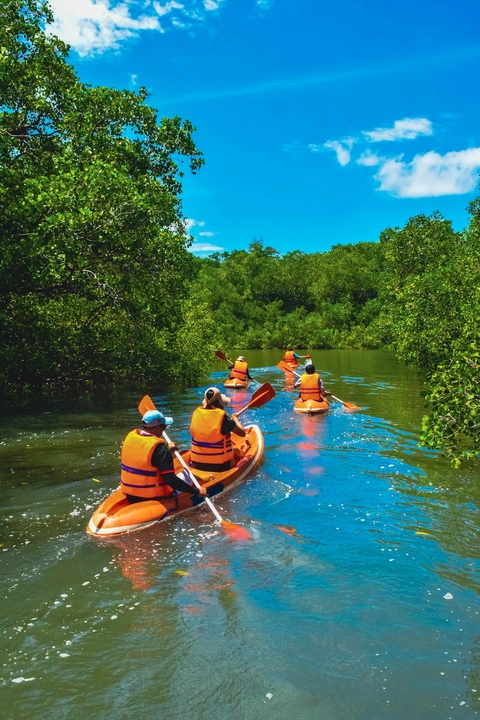
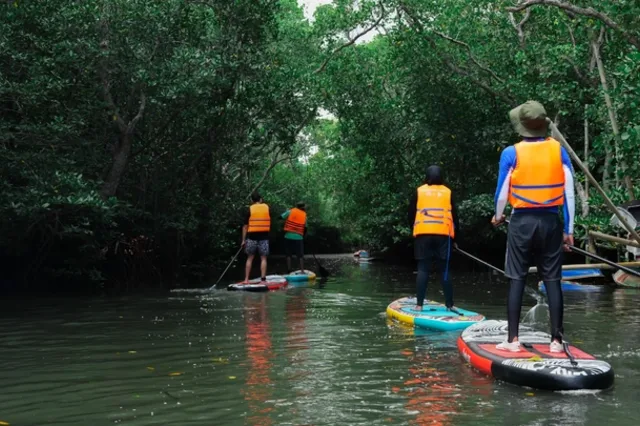
Once the group settles into a rhythm, the experience becomes quieter. The canoe sits low on the water, bringing the roots, mudbanks, leaves, and surface movement close to eye level. Narrower sections feel enclosed by greenery; more open water reveals how the forest connects to the surrounding coast.
Small sounds become easier to notice: a paddle entering the water, leaves moving in the wind, a bird call, or activity beneath the surface. Wildlife sightings depend on the day and cannot be guaranteed. The better expectation is observation rather than a checklist. Even without a dramatic encounter, the structure of the forest and the transition between land and water give the route its character.
Why mangroves matter to Bali
Mangroves survive in conditions that challenge many other plants. Their root systems occupy tidal ground where salt water, fresh water, low oxygen, shifting sediment, and changing water levels meet. Different species use specialised roots and physiological adaptations to live in this environment.
These forests help stabilise shorelines and trap sediment. They create habitat and nursery areas for marine and coastal life, while their branches and mudflats can support resident and migratory birds. Mangroves also store carbon in vegetation and waterlogged soils, although the value of an individual site should never be reduced to a single climate statistic.
For communities around a bay, ecological health and everyday livelihoods are connected. Fisheries, water quality, coastal protection, and tourism all interact with the same landscape. A guided visit cannot solve every environmental pressure, but it can make an ecosystem that is often passed at road speed more visible and understandable.
The environmental value of Benoa Bay also explains why visitors should treat the route as habitat rather than an adventure playground. Quiet movement, following the guide, taking waste home, and avoiding contact with roots or wildlife are simple but important behaviours.
The role of Wana Segara Kertih
The tour is conducted in cooperation with the local community and the fishermen’s group Wana Segara Kertih. This local relationship is one of the most meaningful parts of the experience. Knowledge of tides, routes, weather, and the coastal environment is practical knowledge, built through repeated contact with the place.
Community-based does not mean visitors should romanticise local life or assume every environmental issue is simple. It means the experience is connected to people who live and work around the landscape. Listening to the guide and asking thoughtful questions can provide more context than treating the mangrove as a background for photographs.
When evaluating any nature activity, look beyond labels such as “eco.” Ask what actually happens: who guides the experience, whether safety decisions respond to natural conditions, whether the group follows an appropriate route, and whether the activity supports local participation. Those details are more useful than a vague sustainability claim.
A typical journey from hotel pickup to return
For guests using the included transfer from an eligible hotel area, the experience begins with pickup in an air-conditioned, non-smoking vehicle. Pickup coverage currently includes centrally located hotels in Kuta, Legian, Tuban, Sanur, Jimbaran, Tanjung Benoa, and Nusa Dua. Other areas may require a surcharge, and distant pickups may not be recommended.
After arriving at Wana Segara Kertih, participants receive guidance before entering the water. The briefing covers the paddle, canoe balance, the route, guide instructions, and safety equipment. Life jackets must be worn throughout the activity.
The canoe journey normally lasts about 1 to 1.5 hours. The exact route and timing respond to tides, weather, and water conditions. At the end, the canoe returns to the starting area before the transfer back to the hotel.
Pickup coverage and surcharges can change, so enter your real hotel details when booking. If you are staying in Ubud, Canggu, Pecatu, Uluwatu, Tabanan, Tanah Lot, Candidasa, or North Bali, contact the team before building the activity into a fixed itinerary.
Is the tour suitable for beginners?
Yes. The tour is designed to be accessible to people without previous canoeing experience. The guide explains the basic technique and safety procedure before the group starts. The route generally uses calm mangrove waterways, although no outdoor water environment is identical every day.
Beginner-friendly does not mean completely passive. You still need to enter and sit in a canoe, hold a paddle, follow instructions, and remain comfortable on the water. If you have limited mobility, a relevant medical condition, strong anxiety around water, or uncertainty about swimming ability, contact the operator before booking rather than waiting until pickup.
Single and tandem canoes may be used. A tandem arrangement can be helpful for a parent and child, a couple, or anyone who prefers to coordinate with another paddler. Final canoe allocation depends on operational arrangements and should be confirmed with the team.
Families and children
The minimum joining age is five years. Child pricing applies to ages 5–11, and children must be accompanied by a parent or guardian. Insurance applies only to participants aged 5–65 under the current product conditions.
For a family, the short activity length can be an advantage. It offers real time outdoors without requiring a full-day expedition. The environmental interpretation can also turn the paddle into an informal learning experience, especially when adults encourage children to observe quietly rather than focus only on speed.
Parents should consider more than the minimum age. A child should be able to wear a life jacket correctly, remain seated, follow the guide, and cope with heat, splashes, insects, and an unfamiliar water environment. Bring sun protection, drinking water as provided, and a change of clothes if your child is likely to get wet.
Pregnant guests are not permitted to join. If any family member has a medical or accessibility concern, discuss it with the operator before payment.
What to wear and bring
Choose lightweight clothes that can handle paddle splashes and dry reasonably quickly. Sportswear, a breathable top, and shorts or light trousers usually work better than heavy denim. Wear secure footwear that you do not mind getting damp; avoid anything that slips off easily.
A hat, sunscreen, sunglasses with a retaining strap, and insect repellent can be useful. Bring a small towel and a change of clothes, especially if you have another activity planned afterwards. Keep valuables to a minimum and use a waterproof phone pouch rather than assuming a pocket or ordinary bag will stay dry.
The tour currently includes mineral water, life jacket and first-aid provision, canoe or kayak equipment, guide service, land transportation from covered areas, insurance for eligible ages, donation, and applicable tax. Meals, additional beverages, personal expenses, and gratuities are not included according to the current listing.
Do not bring loose packaging that can fall into the water. If you carry a snack, sunscreen, or other small item, keep it secured and take every piece of waste back with you.
Weather, tides, and the best time to go
There is no single month that guarantees perfect mangrove conditions. Bali’s broad dry season often brings more settled weather, while the wetter months can bring heavier showers and greater day-to-day variability. Local weather can still change in any season.
Tide is just as important as rain. Water level influences which channels are accessible, the current, the visible roots and mudbanks, and the timing of the activity. This is why the operator may adjust the route or schedule even when the sky looks clear.
Light rain does not automatically cancel the tour. Strong wind, lightning, unsuitable water conditions, or other safety concerns may lead to changes or cancellation. Treat that flexibility as responsible operation, not an inconvenience. Check messages from the operator before leaving your hotel and avoid placing a non-refundable, tightly timed booking immediately after the canoe tour.
Safety and participation rules
Wear the life jacket for the entire time on the water, even if you are a confident swimmer. Listen during the briefing and remain within the guide’s route. Avoid standing, leaning suddenly, racing another canoe, grabbing branches, or deliberately disturbing wildlife.
Children must remain with their accompanying adult. Pregnant guests cannot participate. The listed insurance coverage applies to ages 5–65, so travellers outside that range should not assume they are covered. All participants should disclose relevant concerns before the activity.
The operator may change or cancel the route when tides or weather are unsuitable. The current booking page states free cancellation up to 24 hours before the experience begins in Bali time, but policies can change. Read the live terms for your selected date before completing payment.
How to photograph the experience responsibly
The most effective photographs often come from waiting rather than constantly moving the canoe. Keep your phone or camera secured, follow the guide’s direction, and avoid leaning over the side for a low angle. A wrist strap or waterproof case is more useful than carrying multiple pieces of equipment.
Look for the visual layers that make a mangrove distinctive: reflections, arching roots, a narrow opening between trees, the paddle’s wake, or a second canoe moving through the channel. Photograph people only with their permission, particularly guides and community members.
Do not ask the guide to approach wildlife too closely or leave the safe route for a photograph. Never break, pull, or reposition vegetation. A responsible image records the experience without altering it.
How to combine the tour with the rest of your day
Because Kedonganan is in southern Bali, the canoe tour combines most naturally with nearby areas. A relaxed option is to keep the rest of the day around Jimbaran or Kedonganan, allowing time for the beach or an early seafood dinner. Travellers based in Kuta, Tuban, Nusa Dua, Tanjung Benoa, or Sanur can also return without crossing the entire island.
Avoid pairing the tour with a fixed-time attraction in Ubud, East Bali, or North Bali on the same day. The canoe experience may be short, but hotel pickup, traffic, the safety briefing, changing conditions, and the return journey all require time.
If you want another nature-focused activity, consider placing it on a different day. Separating experiences prevents the mangrove from becoming one rushed stop in a long checklist and gives weather-dependent activities more room to adapt.
Who will enjoy this experience most?
This tour suits travellers who want a calm outdoor activity rather than high-adrenaline water sport. It works particularly well for couples, families with eligible children, beginners, nature enthusiasts, photographers who can travel lightly, and visitors interested in a less obvious side of southern Bali.
It may not suit someone expecting fast paddling, guaranteed wildlife sightings, luxury facilities throughout the route, or a completely dry activity. It is also unsuitable for pregnant guests, children under five, and anyone unable to participate safely under the operator’s conditions.
The best reason to join is curiosity. If you are interested in how a forest can grow between land and sea, how local knowledge responds to tides, or how a short journey can reveal a landscape hidden beside busy southern Bali, the experience has real depth.
Questions to ask before booking
Confirm the available date and pickup time, whether your hotel is within the included transfer area, any surcharge for your location, and the estimated total time away from the hotel. Ask whether a single or tandem canoe is most appropriate for your group and disclose any age, mobility, medical, or water-confidence concerns.
Also verify the current price, child policy, insurance eligibility, inclusions, cancellation deadline, and what happens if the operator cancels because of unsafe conditions. If you are planning the tour close to a flight, hotel checkout, boat departure, or another timed activity, share that information before booking.
You can review the latest conditions and availability on the Bali Mangrove Forest Canoeing Tour page, or contact Kura-Kura Bus directly through WhatsApp at +62 812-3729-3689.
Frequently asked questions
How long does the mangrove canoe tour take?
The guided canoe portion is approximately 1 to 1.5 hours. The product is presented as an approximately two-hour activity, while the full time from hotel pickup to return varies with location, traffic, pickup sequence, tide, and weather.
Do I need canoeing experience?
No previous experience is required. The guide provides a briefing on paddling and safety before entering the water.
Do I need to know how to swim?
Life jackets are provided and must be worn. Anyone concerned about swimming ability or comfort on the water should contact the operator before booking so their situation can be discussed properly.
Will I get wet?
Possibly. Paddle splashes are normal, and weather can change. Wear quick-drying clothing and bring a towel or change of clothes.
Can children join?
Children aged five and above may join with a parent or guardian. The current child category is 5–11 years old.
Can pregnant travellers participate?
No. Pregnant guests are not permitted to join under the current safety conditions.
Are wildlife sightings guaranteed?
No. Birds, fish, and other wildlife move according to natural conditions. The experience should be approached as habitat observation rather than a guaranteed wildlife encounter.
What happens in bad weather?
The route, timing, or activity may be adjusted or cancelled when weather, tide, or water conditions are unsafe. Light rain alone may not stop the tour.
Is hotel transfer included?
Round-trip land transport is included from selected centrally located hotel areas in southern Bali. Other areas may have a surcharge or may not be recommended. Confirm using your exact accommodation before booking.
What is included?
The current listing includes eligible hotel transport, an English-speaking licensed guide, donation, applicable tax, mineral water, eligible-age insurance, life jacket, first aid, and a single or tandem canoe or kayak. Meals, other beverages, gratuities, and personal expenses are excluded.
A quieter way to understand southern Bali
Mangrove canoeing is not about covering a great distance. Its value comes from changing your point of view. Southern Bali becomes quieter, the waterline becomes the centre of the landscape, and a forest that is easy to overlook becomes the main subject of the journey.
Go with realistic expectations, respect the safety decisions made for the day, and pay attention to the guide’s explanation. The result is a short experience that can add environmental and community context to a Bali itinerary without requiring an exhausting full-day expedition.
Sources and further reading
Check live prices, availability, pickup coverage, inclusions, and conditions on the official Kura-Kura Bus tour page.
For wider environmental context, consult the Indonesian government’s coastal and marine environmental study for Benoa Bay, which documents mangrove distribution, species, associated birdlife, and environmental pressures in the area.